

What “Credibility” Actually Means on a Plastic Surgery Website
Credibility is not about looking expensive. It is about removing doubt.
Patients considering cosmetic procedures are making decisions that feel enormous to them. They are thinking about their appearance, their safety, and spending thousands of dollars.
Patients need to feel confident before they ever pick up the phone.
The Trust Gap Most Surgeons Don’t Know They Have
Your website probably looks fine to you. The problem is that patients are scanning for very specific signals. When those signals are missing or hard to find, doubt fills the gap and doubt sends them somewhere else.
According to research from Standford, 75% of users judge a company’s credibility based on website design alone.
That number should matter to every plastic surgeon running a practice in a competitive market.
Design, speed, credentials, reviews, and clear next steps, these are not cosmetic details. They are the foundation of how patients decide whether to trust you.
Trust Signal #1 Board Certification and Credentials
Your board certification is one of the most powerful trust signals you have. Most patients do not know what all the acronyms mean, but they know that board certification signals safety and expertise.
If a visitor has to dig through three pages to find it, you’ve already lost the conversion battle.
How to Display Credentials Without Boring Your Visitors
- Display your ABPS board certification clearly, ideally above the fold or in the top navigation.
- Use badge graphics alongside a short line of context. Something like “Board-Certified by the American Board of Plastic Surgery” does more work than a logo alone.
Trust Signal #2 Before and After Galleries That Actually Convert
Patients expect before and afters. What sets a high-converting gallery apart is how it is organized and presented.
A well-built gallery signals competence. A poorly presented gallery with the following:
- Bad lighting
- Inconsistent backgrounds
- No filtering by procedure
signal the opposite.
What Makes a Gallery Lose Credibility Fast
Galleries that are hard to find, load slowly, or dump every photo into one unfiltered grid frustrate patients rather than build confidence.
When someone is researching a facelift, they want to see facelift results, not scroll through 200 mixed images hoping to find relevant ones.
Think of it as a gallery of your work, not an Instagram feed. Treat it like one.
- Organize by procedure.
- Use consistent, clean photography.
- When possible, include a brief context note for each case.
That level of care in the gallery reflects the level of care patients can expect in the operating room.
Trust Signal #3 Patient Reviews
But if your reviews only live on your Google Business Profile and nowhere on your actual website, you are leaving trust on the table.
How to Use Reviews to Answer Objections Before Patients Ask
Pull specific reviews onto your procedure pages, the ones that address common fears about pain, recovery time, or results.
A review that says “I was nervous going in, but my recovery was so much smoother than I expected” does more to convert an anxious patient than any marketing copy you could write.

An example of real customer moments transformed into powerful AI video testimonials.
Video testimonials take this even further.
A real patient speaking on camera carries weight that a five-star text review simply cannot match. If you are not capturing video testimonials yet, this is one of the highest-return investments you can make.
Neur Digital’s AI video testimonial service is built specifically for practices that want to use this kind of content without the production headaches.
Trust Signal #4 A Surgeon Bio That Sounds Like a Human
Most surgeon bios read like a CV.
- Training
- Fellowship
- Hospital affiliations
- Awards
That information matters but it is not what creates a connection.
What to Include in a Bio That Actually Builds Trust
Tell patients why you went into plastic surgery. Share your philosophy on results and patient care.
Use a professional photo that feels approachable rather than clinical.
Patients want to know the person who will be operating on them, not just their credentials.
Think about it this way.
Two surgeons have identical training. One has a bio that lists their degrees. The other explains that they were drawn to reconstructive surgery after watching a family member recover from a serious accident.
Which one feels more trustworthy?
The answer is obvious.
Conversion Element #1 Your CTAs Are Probably Too Vague
“Contact Us” is not a call to action. It is a placeholder that puts the burden of the next step entirely on the patient.
CTA Language That Gets Patients to Click
Be specific about what happens next.
- Book a Consultation
- See If You’re a Candidate
- Request My Private Consultation
All of these CTA’s perform better because they tell the patient exactly what they will get when they click.
Placement matters just as much as language.
CTAs belong above the fold, after every major content section, and especially after your before and after gallery.
Research from DesignRush found that strategic, relevant CTAs can increase revenue by 83%.
Patients who are ready to act should never have to scroll back to the top to find a button.
Conversion Element #2 Your Contact Form Might Be Killing the Lead
Forms are where conversions go to die, especially long ones.
Research shows that 65% of users will abandon a form that asks for too much personal information upfront.
What a High-Converting Contact Form Looks Like
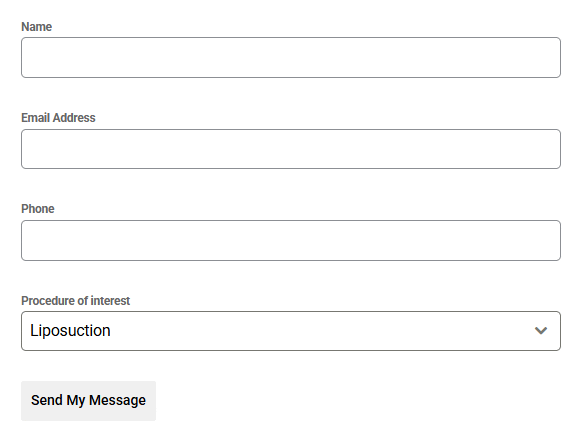
An example of a high-converting plastic surgery contact form.
Keep it to four or five fields:
- Name
- Phone
- Procedure of interest
That is enough to start a conversation without overwhelming someone who is still in research mode.
The confirmation message matters too.
When a patient submits a form, they want to know someone received it and will follow up.
A generic “Your message has been sent” does not inspire confidence. Something like “We will reach out within one business day to schedule your consultation” tells them what to expect.
A well-built website with a tested, working contact form is part of the foundation.
Neur Digital’s website design services are built to make sure that form actually works and that leads do not go missing.
Conversion Element #3 Page Speed and Mobile Experience
It takes only 0.05 seconds for users to form an opinion on your website
Most cosmetic surgery searches happen on a phone. Often late at night, when someone finally has a quiet moment to research something they’ve been thinking about for months.
If your site frustrates them in those first few seconds, they are gone.
Quick Wins for Improving Plastic Surgery Website Speed
Compress your gallery images. This is almost always the biggest culprit on plastic surgery sites.
Use a reliable host, a clean theme, and avoid loading your site down with unnecessary plugins.
Speed is not just a user experience issue. It is an SEO issue.
Google uses page speed as a ranking signal, which means a slow site is also a harder site to find.
How SEO and Website Credibility Work Together
A credible website that no one can find is still a problem. And a website that ranks well but fails to convert is equally frustrating.
The good news is that the same elements that build patient trust also help you rank better, especially as AI search engines like ChatGPT start surfacing local providers based on content quality, credential signals, and how well a site answers patient questions.
What AI Search Looks for When Recommending a Plastic Surgeon
AI search is getting more sophisticated at evaluating whether a source is trustworthy. Clear credentials, consistent contact information, patient-focused content, and a website that loads fast all contribute to how your practice gets surfaced in AI-driven results.
According to a 2025 analysis, SEO was the highest-converting digital channel for plastic surgery practices, driven by patients actively researching procedures.
That is not an accident.
Patients who find you through search are already in research mode. When your site earns their trust, the conversion happens naturally.
If you want your site to perform on both fronts, Neur Digital’s plastic surgery SEO services are built around exactly this; combining content strategy, local visibility, and AI search optimization to help practices fill their consultation calendars.
The Bottom Line
Credibility and conversions are the same problem wearing different labels.
When your site clearly displays credentials, shows great results, makes it easy to contact you, and loads fast on any device, patients trust you before they ever speak to your front desk.
That trust is what turns a website visitor into a booked consultation.
If you’re not sure where your site is falling short, a second set of eyes goes a long way.
Reach out to us for a free strategy call and we’ll take a look at what your website is doing and what it could be doing better.


