

The Best Local SEO Tactics for a Cosmetic Surgery Practice
Local SEO for aesthetic surgeons starts with your Google Business Profile. It’s often the first thing a patient sees before they ever land on your website.
Here’s what to prioritize.
- Claim and complete your Google Business Profile. Add every procedure you offer, current photos, and accurate hours.
- Build location-specific landing pages. If you have multiple offices, each one needs unique content, not a copy-paste job.
- Generate and respond to reviews. RealSelf, Google, and Yelp reviews influence both rankings and patient trust.
- Keep your NAP consistent. Your name, address, and phone number should match exactly across every directory and listing.
- Add schema markup. This helps search engines understand your practice, procedures, and location data.
None of these tactics work in isolation.
Effective SEO for aesthetic surgeons comes from layering them together and maintaining them consistently, not setting them once and forgetting them.
Think about how a prospective patient actually searches. They rarely type one clean phrase and stop there. They compare a handful of practices, read reviews, and check before-and-after photos before ever picking up the phone.
Your local SEO needs to show up at every one of those steps, not just the first search.
How to Improve Local SEO for Aesthetic Surgeons in the US
The Google Trends data above proves a point. Local SEO for aesthetic surgeons isn’t one-size-fits-all across the country.
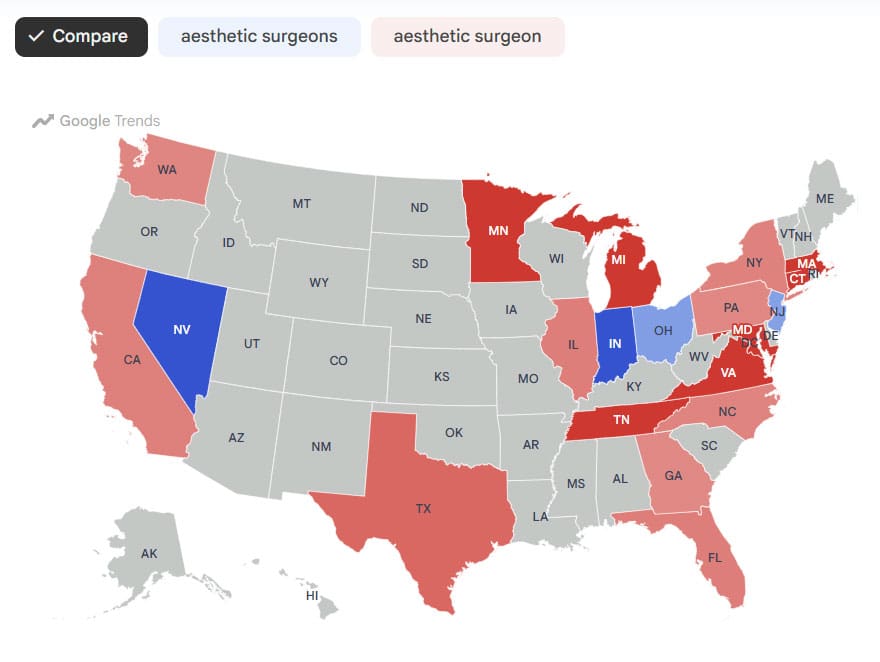
A practice in Ohio and a practice in Texas are competing in different search landscapes, even for procedures that sound identical. What ranks in one metro rarely translates directly to another.
To improve local SEO for aesthetic surgeons in the US, focus on these three areas.
- City and state-level content. Write pages and blog posts that speak to your specific market instead of generic national copy.
- Localized backlinks. Partnerships with local med spas, press mentions, and community sponsorships build the authority Google trusts.
- On-page local signals. Your location belongs in title tags, headers, and image alt text, not buried in a footer.
What Is GEO, and Why It Matters
Generative Engine Optimization, or GEO, is the newest layer of SEO for aesthetic surgeons to understand.
It covers how you show up when patients ask ChatGPT, Gemini, or Google AI Overviews for recommendations instead of typing into a traditional search bar.
This shift is already happening.
Recent research found that 37% of consumers now start their searches with AI tools instead of Google, not a search engine at all.
Healthcare searches are moving even faster. AI Overviews now show up on roughly 88% of healthcare queries, up from 76% in early 2024, according to Zocdoc’s research citing BrightEdge data.
That means the patient asking “who’s the best rhinoplasty surgeon near me” might never see a traditional search result at all.
To win in GEO, structure your content so each section can stand alone. AI tools pull pieces of pages, not entire articles, when building an answer.
Clear headers, direct answers, and strong credibility signals all help your practice get cited instead of skipped over.
Recommended SEO Tools for Tracking Plastic Surgery Keywords
You can’t improve what you don’t measure. Any real strategy for SEO for aesthetic surgeons starts with tracking plastic surgery keywords across both traditional rankings and AI search.
A few tools worth knowing.
- Google Search Console. Free, and it shows exactly how Google crawls and indexes your site.
- Ahrefs or SEMrush. These track keyword rankings and competitor movement over time.
- BrightLocal. Built specifically for local rank tracking and citation management.
- Otterly.AI. Tracks brand mentions, sentiment, and share of voice across AI search platforms.
Learning these platforms takes real time.
Most take weeks to understand well enough to make confident decisions about SEO for aesthetic surgeons, and even longer to interpret the data correctly and act on it.
That’s a fair trade if you have the bandwidth for it. If you don’t, working with an SEO specialist for aesthetic surgeon marketing means someone is watching these numbers daily and adjusting strategy, not just running a quarterly report.
Neur Digital runs the same AI search monitoring system on our own brand that we build for clients.
Over 60 days, we earned a 90% share of voice across our tracked topics using this process, along with 166 brand mentions across AI platforms.

We offer AI search monitoring services built around that same process, so your practice knows exactly where it stands instead of guessing. If you want a closer look at how the tools stack up against each other, we broke it down in our guide to AI search monitoring tools.
Growing Your Practice Through SEO Doesn’t Have to Be a Guessing Game
SEO for aesthetic surgeons isn’t a set-it-and-forget-it project. It changes by state, by platform, and now by whether a patient is asking Google or asking AI instead.
The practices that grow are the ones treating SEO as an ongoing strategy, not a one-time website update they check off a list.
If you have questions about your current rankings, or want a second set of eyes on your plastic surgery SEO, our team at Neur Digital is happy to talk it through. No pressure, just a conversation about where your practice stands today.


