
What Is Search Intent? Why Does It Matters for Medspa SEO?
Search intent is the purpose behind someone’s online search. What they’re trying to learn, decide, or buy.
Search intent matters for medspa SEO because Google rewards websites that match this purpose. Not those that repeat keywords over and over.
When your content aligns with what a patient wants, you rank higher and attract clients who have interest.
Think of it this way: a woman sits on her couch after work, zooming in on her reflection during a video call replay.
She searches “microneedling for acne scars” because she wants answers.
Later that week, she searches “microneedling near me” because she’s ready to take action.
Two searches, two very different intentions.
The first intent was for answers. The second intent is for an appointment.
If your medspa doesn’t speak to both intents, you miss the chance to meet her exactly where she is.
There are four main types of search intent:
- Informational: Users are looking for information (“What is microneedling?”)
- Navigational: Users want to go to a specific site (“NeurDigital blog”)
- Transactional: Users are ready to take action (“Book Botox near me”)
- Local: Users want services in their geographic area (“Medspa in Chicago”)
When your content speaks to all of these steps, you guide patients naturally toward your medspa..
High-Intent Keywords by Medspa Service
Once you understand how intent shapes every search, the next step is knowing what patients are typing into Google or ChatGPT.
Think of each medspa service as its own conversation and every keyword as a moment in that conversation.
When you tap into these service-specific keywords, you stop guessing and start guiding.
Below, you’ll find a few medspa SEO keywords that consistently attract motivated patients. They are organized by service and intent so you can see where the opportunities are.
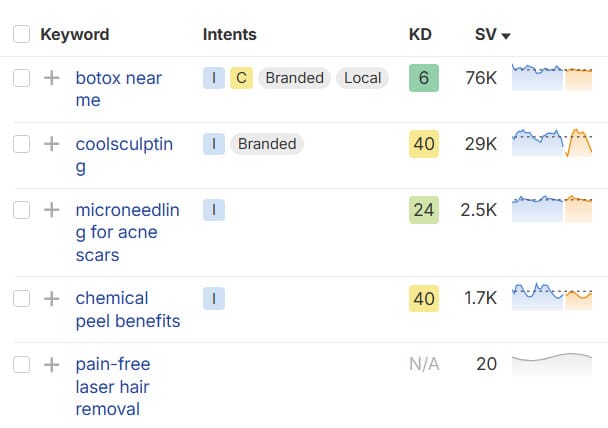
Keyword research for medspa SEO
Injectables (Botox, Fillers)
- “Botox near me” — Local / Transactional
This is someone who’s ready to find a provider in their area. - “Lip fillers cost [city]” — Commercial
Prospective clients are doing research on price before committing. - “Dermal filler safety risks” — Informational
These users want reassurance and medical credibility.
Laser Hair Removal
- “Laser hair removal [city]” — Local
Captures high-intent clients searching in your area. - “Pain-free laser hair removal” — Informational
Addresses a common fear and educates. - “Laser hair removal cost per session” — Commercial / Transactional
People want to know the investment before booking.
Targeted keywords help you position your medspa as a trustworthy local provider and a spa that understands your client’s concerns.
Skin Rejuvenation (Microneedling, RF, Resurfacing)
- “Microneedling for acne scars” — Informational
Attracts people researching solutions. - “Skin resurfacing treatment near me” — Local
For clients ready to get treated. - “RF skin tightening results before after” — Commercial
Potential clients want proof and visual outcomes.
Long-tail phrases give your medspa SEO a powerful advantage.
You’ll be found by people who are curious and weighing their options.
You’ll also be optimizing for AI search.
Body Contouring
- “CoolSculpting in [city]” — Local / Transactional
Ideal for high-intent patients ready to book. - “Non surgical fat reduction” — Informational
Educational content helps clients feel informed and confident. - “Emsculpt vs CoolSculpting” — Comparative / Informational
These are clients who are evaluating based on results, cost, or downtime.
Because body contouring is often a significant financial and lifestyle decision, these keywords help you attract educated and motivated patients who are ready to commit.
Facials / Peels
- “Hydrafacial near me” — Local
Captures folks looking for that specific facial from a nearby medspa. - “Chemical peel benefits” — Informational
Educates about different peel types and what they treat. - “Anti-aging facial cost” — Commercial
Prospective clients want to know what to budget for.
Facial and peel treatments often serve as “gateway” services.
Once someone trusts your medspa for a facial, they may come back for injectables or more advanced treatments.
Keyword Strategy Best Practices for Medspa SEO
Putting together a smart medspa SEO strategy isn’t just picking keywords.
It’s about organizing and executing them effectively:
- Cluster by intent and service.
- Group your keywords into content themes (e.g., blog posts, service pages, specials, etc.).
- Strengthen local SEO. Include your city or neighborhood in your page titles, meta descriptions, headers, and on-page content.
- E-E-A-T. Content should reflect your Expertise, Experience, Authority, and Trustworthiness.
- Use internal links. Link from blog content to your service pages and back to your contact page. Make the links make sense. Don’t make your patients think too hard.
How to Measure SEO Success
Once you’ve put your medspa SEO keyword strategy into motion, the real question becomes: Is it actually working?
Think of it like watching a treatment plan unfold.
First, you’ll notice the early signs. Your traffic starts to climb as more people discover your site.
Then you begin seeing your keyword rankings rise in Google Search Console. Especially for the medspa terms you’ve targeted.
But the real transformation shows up in your conversions. Are you seeing more consultations, more bookings, more new faces walking through your door?
And if the numbers aren’t moving, then that’s a sign the strategy needs a tune-up.
Sometimes that means adjusting your keywords. Other times, it means bringing in medspa marketing specialists who can diagnose the gaps and accelerate your results.
Conclusion + Next Steps
A thoughtful, intent-driven medspa SEO strategy is a powerful way to attract the right clients to your practice.
When optimized correctly, your website becomes more than just a digital brochure. It becomes a conversion engine.
If you’re ready to map out a custom keyword strategy then contact us at for a free medspa SEO audit.
Curious how optimizing for medspa SEO could increase your traffic and bookings?
Let’s talk — we’d love to help your medspa grow.