

What Local Cosmetic Surgery Search Engine Optimization Actually Means
Most people think SEO means showing up on Google. That’s true, but it’s only half the picture.
Local SEO is showing up on Google in your city, when someone types “rhinoplasty in Chicago” or “breast augmentation near me.”
That’s a very different target than ranking for broad terms like “plastic surgeon.”
The local map pack is the three business listings that appear at the top of Google search results.

An example of when a patient searches “rhinoplasty in Chicago” and three names win. Local cosmetic surgery SEO determines who makes the list.
If you’re not in those three spots, you’re invisible to most searchers.
According to Northstone Insights, 77% of patients use search engines before booking an appointment, and 88% of local searches on mobile result in a call or visit within 24 hours.
Your Google Business Profile Is Your Local Front Door
Think of your Google Business Profile (GBP) as the digital version of your front desk.
It’s often the first thing a patient sees before they ever visit your website.
Most practices set it up once and forget it.
That’s a mistake.
What Your GBP Needs to Be Competitive
Your profile should have your:
- Practice name
- Address
- Phone number
- List your primary category as “plastic surgeon” — not “doctor.”
- Include high-quality photos of your office, staff, and team.
- Be updated regularly with posts about procedures, offers, or educational content
Your front desk can own this.
Assigning one person to monitor the GBP weekly, updating hours, responding to questions, and flagging outdated info, makes a measurable difference in local rankings.
Reviews Are a Ranking Signal, Not Just a Reputation Tool
Here’s something most surgeons don’t realize: Google uses your reviews to decide where to rank you locally.
Net One Click’s 2026 research found that more than 94% of patients read reviews before booking, and 84% will not consider a provider rated below four stars.
That stat alone should make reviews a front desk priority, not an afterthought.
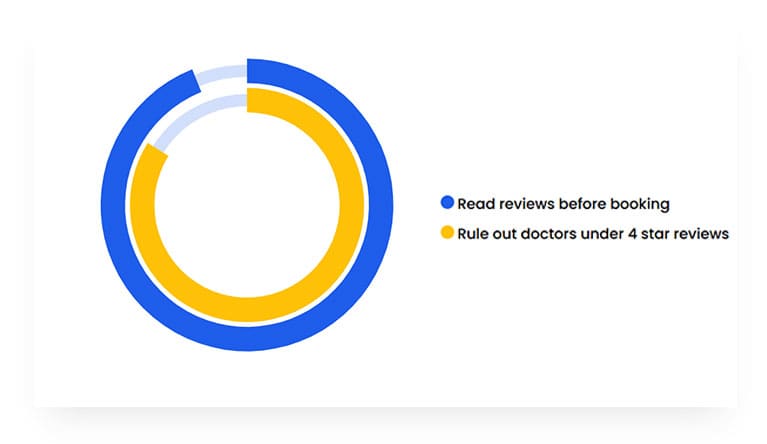
Before a patient ever calls your office, your reviews already made the decision for them.
How to Ask for Reviews Without Making It Awkward
The best time to ask is right after a positive interaction.
A post-appointment follow-up text or email with a direct link to your Google review page works well.
Keep it simple and make it easy.
Responding to every review also matters.
Thanking a happy patient shows attentiveness. Responding professionally to a negative one shows character.
Both signal trust to Google and to the patients reading them.
Local Keywords and Location Pages That Rank
Broad procedure pages rank for broad searches.
That’s fine.
But they won’t win you the local market.
What does win locally is geo-targeted content. Pages and blog posts that include terms like “facelift in Los Angeles” or “mommy makeover Miami” tell Google exactly where you operate and who you serve.
For cosmetic surgeon SEO, location-based keywords are one of the highest-leverage tactics available.
Build Location Pages for Every Market You Serve
If your practice serves multiple cities or neighborhoods, each one deserves its own page.
That page should include the location name naturally throughout the copy, your address and contact info, and content specific to that area.
A single “contact us” page covering three cities won’t rank in any of them.
This is a longer-term play, but it compounds over time.
Practices that invest in local content consistently outperform those that don’t, often without spending a dollar on ads.
Citation Consistency — The Detail Most Miss
Citations are any online listing that includes your practice name, address, and phone number like:
- Healthgrades
- RealSelf
- YellowPages
- And dozens of smaller directories
The problem is inconsistency.
If your address is listed differently across platforms — a suite number here, a shortened street name there — search engines lose confidence in your data. That confusion can drag down your local rankings even if everything else is dialed in.
A Simple Audit Your Team Can Do This Week
Google your practice name and write down every listing that appears.
Check each one for accuracy.
For example, is your address Ste., STE or Suite?
Your name, address, and phone number should be identical everywhere.
If they’re not, update them. This is one of those tasks that looks small but carries real SEO weight.
There are also paid tools like BrightLocal or Moz Local that automate citation tracking if your team is managing multiple locations.
What to Do If This Feels Overwhelming
Local cosmetic surgery SEO has a lot of moving parts.
- Google Business Profile management
- Keyword strategy
- Citation audits
- Location pages
- Review generation
It adds up fast, especially for a busy practice.
The good news is you don’t have to manage all of it yourself.
A good digital marketing partner takes the heavy lifting off your plate while keeping your team informed on what’s working.
Neur Digital specializes in local SEO for plastic surgeons and plastic surgery SEO built around the patient behavior and competitive dynamics in the aesthetic space.
If your practice is losing ground to competitors in local search, or you’re not sure where you stand, that’s a conversation worth having.
You can reach out to start a conversation.
No pressure, just clarity on where your practice stands and what’s possible.
The Bottom Line
Patients are searching for you right now. The only question is whether they’re finding you or not.
Local cosmetic surgery search engine optimization isn’t a trend. It’s the foundation of how patients discover and choose a surgeon.
A complete Google Business Profile, consistent citations, geo-targeted content, and an active review strategy are not optional extras.
They’re the baseline.
Start with one thing this week.
- Audit your GBP.
- Check your citations.
- Ask your next happy patient for a review.
Small actions stack up faster than most practices expect.
And if you want help building a system that does this consistently, Neur Digital is ready when you are.


