

1. They’re Chasing Traffic Instead of Patients
More traffic sounds great.
Real-life story time…and this one still makes us chuckle.
We once worked with a roofing company in Illinois.
One of their blog topics was on Hurricanes and Your Roof. And on paper, it looked great. Low difficulty, high search volume. The numbers made it tempting.
The only problem? Illinois doesn’t get hurricanes. It was the right keyword in the wrong zip code.
Great SEO in healthcare means nothing if the content doesn’t match where your reader actually lives (literally).
A generalist agency optimizes your site to attract visitors. A healthcare SEO agency optimizes to attract patients.
Those are two completely different goals.
Ranking for “what causes lower back pain” pulls in curious readers doing research. Ranking for “lower back pain specialist accepting new patients in Dallas” pulls in people ready to book.
The first looks great in a monthly report. The second fills your schedule.
What patient-focused healthcare SEO actually looks like
It starts with search intent. Every page, every blog post, every service description should match where a patient actually is in their decision journey.
Local SEO is just as important.
Your Google Business Profile, location-based keywords, and patient review signals all feed into how your practice ranks in your market. If your agency isn’t actively working those levers, that’s a conversation worth having.
2. They’ve Never Heard of YMYL
YMYL stands for “Your Money or Your Life.” It’s the classification Google uses for content that could directly impact someone’s health, finances, or safety.
Healthcare content falls right in the middle of it.
YMYL pages are held to a significantly higher standard by Google’s quality reviewers.
Thin blog posts, recycled content, and keyword-stuffed pages don’t just underperform in healthcare, they can actively pull your rankings down.
According to Google’s Search Quality Evaluator Guidelines, medical content requires the highest levels of accuracy, credibility, and authoritativeness to rank well.
Why E-E-A-T matters more in healthcare than almost anywhere else
Google evaluates healthcare content through the lens of E-E-A-T:
- Experience
- Expertise
- Authoritativeness
- Trustworthiness.
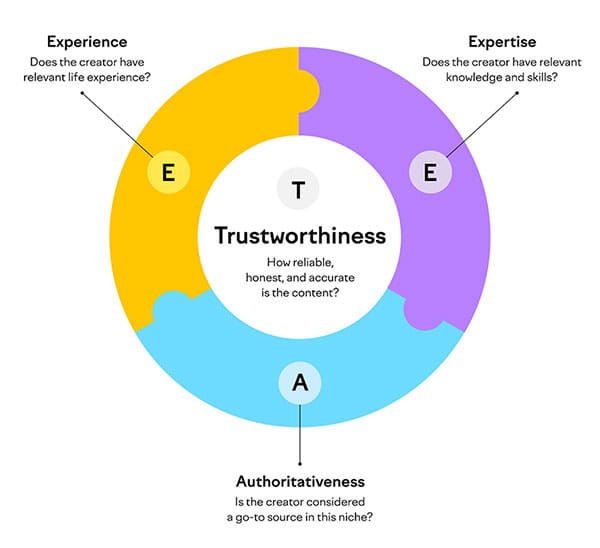
E-E-A-T graphic for healthcare SEO. Source.
A generalist agency producing surface-level content doesn’t come close to clearing that bar.
Your content needs real clinical credibility behind it.
That means thorough provider bios, condition-specific pages written with depth, and content that reflects what your patients are searching for and worried about.
If your healthcare SEO agency has never once brought up YMYL or E-E-A-T in a strategy conversation, that’s worth addressing directly.
3. Their Reports Look Great but Measure the Wrong Things
Impressions. Keyword positions. Organic sessions. These numbers fill up a slide deck nicely.
They don’t tell you whether a single patient walked through your door.
Vanity metrics are easy to report and difficult to argue with. That’s exactly why generalist agencies lean on them.
A healthcare SEO agency should be connecting organic search activity to actual patient actions; phone calls, appointment form submissions, consultation requests.
The numbers that actually matter in healthcare marketing
Ask your agency these questions directly:
- How many calls came from organic search last month?
- Which pages are generating the most patient inquiries?
- What’s the conversion rate on your top-performing service pages?
If they can’t answer those questions, you don’t have a healthcare marketing partner. You have a traffic vendor.
To put real results in perspective, from our medical device marketing case study, we produced a 99% increase in total purchases and $415,000 in additional revenue for our client. An increase driven entirely by organic search.
That’s what it looks like when healthcare SEO is built around outcomes.
4. Their Content Could Belong to Any Practice
Pull up your last three blog posts. Remove your practice name. Could that same content belong to a clinic three states away? A completely different specialty?
If the answer is yes, there’s a real problem.
Generic content doesn’t build patient trust. It doesn’t answer the specific questions your patients are asking before they call. And it doesn’t signal to Google that your site is an authoritative, relevant resource in your specific area of care.
What specialty-specific, patient-centered content actually looks like
Good healthcare content speaks to real patient concerns before they ever pick up the phone.
It addresses the conditions you treat, what patients can expect during care, and why your team is the right choice. It earns trust long before a patient books an appointment.
Effective healthcare marketing pairs that content strategy with consistent publishing, on-page optimization, and quality backlink building.
Each piece compounds over time, building authority that a competitor with generic content simply can’t match.
5. They Don’t Understand How Long Healthcare Decisions Take
Choosing a healthcare provider is not like buying shoes online. It involves research, comparison, sometimes second opinions, and trust built slowly over multiple touchpoints.
Generalist agencies are often wired for fast conversions. They set timelines based on e-commerce clients or lead-gen campaigns.
Healthcare doesn’t follow that playbook.
Why patience is actually part of the strategy
Healthcare SEO is a long-term investment.
Organic authority accumulates over months, not weeks. Practices that stay consistent with their healthcare digital marketing, publishing regularly, earning quality links, optimizing technical performance, see results that compound meaningfully over time.
Neur Digital grew a client’s organic traffic by 143% in five months and improved SEO keyword rankings by 98% across an 18-month engagement.
According to a 2025 post by Semrush, healthcare websites that consistently publish expert content see significantly higher domain authority growth compared to those that don’t.
If your agency promises dramatic results in 30 to 60 days, ask them exactly how. The answer will tell you everything.
The Right Healthcare SEO Agency Makes the Difference
Healthcare SEO is not a specialized version of regular SEO. It’s a different discipline with different content standards, a different audience mindset, and a fundamentally different sales cycle.
The agencies that understand this build strategies to move rankings and patients.
If any of these five signs feel familiar, it may be time to take a closer look at who’s managing your online presence. And if you have questions about what a smarter healthcare marketing strategy looks like for your practice, we’re here to help.