

What Is GEO, Exactly?
GEO stands for Generative Engine Optimization. It’s the practice of making your brand, practice, or content visible and recommended within AI-generated responses.
Traditional SEO targets search engine rankings. You optimize a page to rank #1 on Google.
GEO targets something the actual answer an AI produces when someone asks a question.
The platforms that matter right now include:
- ChatGPT
- Perplexity
- Google AI Overviews
- Gemini
- Copilot
Each of these tools generates a response based on what it finds credible, relevant, and well-structured. You don’t show up in a list of ten blue links. You get mentioned, cited, or recommended in prose.
That’s a fundamentally different game. And most plastic surgery practices aren’t playing it yet.

Plastic surgery SEO gets you clicked. GEO for plastic surgeons gets you quoted. Are you optimizing for both?
How AI Search Tools Decide What to Recommend
Understanding what drives AI recommendations starts with one key insight: AI tools don’t just pull from the same sources Google does.
A recent case study published by Search Engine Land (April 2026) examined why some brands appear consistently in ChatGPT responses while others are nearly invisible. The findings were striking.
Researchers ran the same prompt 68 times and tracked which brands ChatGPT mentioned.
They found that a brand could dominate Google’s search results for relevant queries and still underperform in ChatGPT.
The variable that predicted ChatGPT visibility most accurately was not Google ranking. It was Bing.
Key finding:
87% of ChatGPT citations align with Bing’s top results, according to research cited in the study.
Brands that ranked well in Bing for relevant query variations appeared in ChatGPT recommendations far more consistently than those that relied solely on Google performance.
For plastic surgeons, this matters because most practices have invested almost nothing in Bing visibility.
If ChatGPT is pulling heavily from Bing results to shape its recommendations, that’s an overlooked gap with real patient-acquisition consequences.
Beyond Bing, AI tools generally favor content that is authoritative, specific, and consistent across multiple sources.
A practice with strong reviews, a well-optimized Google Business Profile, accurate directory listings, and detailed procedure content is simply easier for an AI to trust and recommend.
What Good GEO Actually Looks Like for a Plastic Surgery Practice
Your Website Content Needs to Answer Real Patient Questions
AI tools are trained to find answers.
If your procedure pages don’t actually answer the questions patients ask, you’re invisible to generative search.
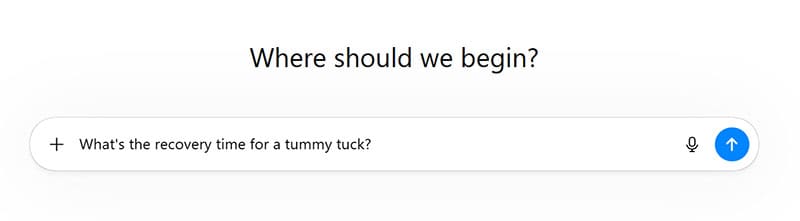
ChatGPT search results example for a plastic surgery SEO query
Think about what patients type into ChatGPT:
- What’s the recovery time for a tummy tuck?
- How do I know if I’m a good candidate for a facelift?
- What’s the difference between a breast lift and breast augmentation?
Your content needs to answer those questions clearly and directly.
FAQ sections on procedure pages, detailed patient education content, and conversational language all help. Each page should be able to stand alone as a credible, complete answer to a specific question.
This also connects to your broader plastic surgery marketing strategy.
Content built for GEO tends to perform better in traditional SEO and social repurposing as well.
Your Online Presence Needs to Be Consistent and Credible
AI tools cross-reference multiple sources before generating a recommendation.
If your name, address, and phone number are inconsistent across directories, that erodes credibility.
Audit your NAP (name, address, phone) information across:
- Bing
- Healthgrades
- Zocdoc
- RealSelf
- And any other directories where your practice is listed.
They should all match exactly.
Recent, positive patient reviews also signal trustworthiness to AI systems.
A practice with 400 reviews averaging 4.8 stars is more likely to be recommended than one with 40 reviews, even if the quality of care is identical.
Structured Data and Technical Foundations Matter
Schema markup is code added to your website that helps search engines and AI tools understand what your content is about.
For plastic surgeons, this includes marking up your practice name, specialty, location, and individual procedures.
You don’t need to understand the code itself.
But your web developer or digital marketing partner should be implementing schema across your site.
Page speed and mobile optimization also matter. AI tools favor sources that are technically sound.
If your site is slow, hard to crawl, or lacking structured data, that’s a foundation problem worth fixing before any content work begins.
Tools You Can Use to Track Your GEO Performance
You can’t improve what you can’t measure. A few tools worth knowing:
- Otterly.ai — Monitors how your brand appears across AI search platforms. It tracks mentions, citations, and visibility trends in tools like ChatGPT and Perplexity. Good for getting a baseline and spotting gaps.
- AirOps — Helps build content workflows optimized for AI discovery. Useful if you’re producing a high volume of content and need it structured in ways that AI tools can parse and cite.
- Ahrefs — A strong tool for content gap analysis and authority building. Use it to identify what content competitors have that you don’t, and to monitor your backlink profile, which influences how credible your site appears to both search engines and AI tools.
None of these tools replace plastic surgery marketing strategy. They surface data. What you do with it is what drives results.
Quick Wins Your Front Desk or Office Manager Can Start On
You don’t need a full plastic surgery marketing agency to make progress. There are several things someone on your team can do this week.
- Audit your Google Business Profile. Make sure your hours, address, phone, website, and specialty information are accurate and complete. Add recent photos if you haven’t in the last 90 days.
- Check your reviews. Are they recent? Are they being responded to? A pattern of unanswered reviews signals neglect to both patients and AI tools.
- Search your practice name across directories. Google your practice name and look at the listings that surface. Note anywhere your NAP information differs from your primary website.
- Flag thin procedure pages. Look at your top five procedure pages. Do they actually answer the questions a patient would ask? If each page is under 400 words with no FAQ content, flag those for a content update.
These steps won’t transform your AI visibility overnight. But they close easy gaps that hold practices back from being recommended.
When to Bring in a Digital Marketing Partner
There’s a ceiling to what a busy practice can do internally.
- Monitoring AI search visibility
- Building schema markup
- Closing directory gaps
- Developing procedure content
- Making edits to the website
- Posting on social media
All of this requires time and expertise most front desks don’t have.
The signs you’ve hit that ceiling usually look like this:
You know GEO matters but aren’t sure where to start, your team has made some updates but nothing is measurable, or you’re watching competitors show up in AI responses while you don’t.
A digital marketing partner who specializes in plastic surgery marketing can audit your current AI visibility, build a content strategy designed for generative search, and handle the technical work your team shouldn’t have to figure out.
If you’re not sure where your practice stands, it’s worth a conversation.
Reach out to Neur Digital with any questions or to talk through what GEO improvements might look like for your practice.
GEO for Plastic Surgeons Conclusion
GEO for plastic surgeons is not a replacement for what you’ve already built. It’s an extension of it.
The practices that show up in AI recommendations have clear, credible, well-structured content across their website and online presence.
The shift doesn’t have to be overwhelming.
Start with the quick wins, track what you can measure, and get support where the work exceeds your bandwidth.
Generative search isn’t slowing down.
The practices that optimize for it now will be the ones patients find when they stop Googling and start asking.